ENErgast biom
Introduction and Product Rationale
Functional gastrointestinal balance depends on the coordinated interaction between intestinal epithelial integrity, immune regulation, and the composition and activity of the gut microbiome. Disruption of this balance may occur in a wide range of real-world contexts, including dietary changes, stress exposure, post-infectious states, and antibiotic use. Such perturbations often present not as overt disease, but as functional bowel discomfort, altered transit, bloating, or reduced tolerance to dietary and environmental triggers.
Within this context, two biological elements have emerged as central to intestinal resilience: butyrate availability and microbial ecosystem stability. Butyrate supports epithelial energy metabolism and immune homeostasis, while selected probiotic microorganisms can influence microbial balance and functional tolerance during periods of instability. Addressing only one of these dimensions may limit effectiveness, particularly in individuals with ongoing functional vulnerability.
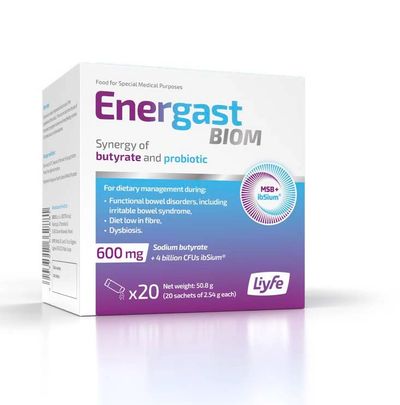
Energast Biome™ was developed to integrate these complementary strategies into a single formulation. The product combines Microencapsulated Sodium Butyrate (MSB®) with Saccharomyces cerevisiae CNCM I-3856 (ibSium®), a clinically studied probiotic yeast. Rather than positioning microbiome modulation and epithelial support as separate interventions, Energast Biome reflects a systems-based approach designed to support both barrier physiology and functional microbial resilience within the gastrointestinal tract.
Biological and Mechanistic Foundations
The intestinal epithelium serves as both a physical barrier and an active metabolic interface between the host and luminal contents. Colonocytes rely heavily on butyrate as their primary energy source, and adequate butyrate availability is essential for maintaining tight junction integrity, regulating epithelial turnover, and limiting inappropriate immune activation. Reduced butyrate exposure has been associated with impaired barrier function and heightened intestinal sensitivity.
At the same time, the functional state of the gut microbiome influences fermentation capacity, immune signalling, and tolerance to dietary substrates. Yeast-based probiotic strains represent a distinct functional category within microbiome support, differing from bacterial probiotics in both structure and mechanism. Saccharomyces cerevisiae CNCM I-3856 (ibSium®) has been investigated for its role in supporting functional bowel tolerance and microbial balance, particularly in individuals experiencing functional intestinal disturbances.
The mechanistic rationale for combining MSB® with ibSium® lies in their complementary actions. MSB® delivers butyrate in a controlled manner along the intestinal tract, supporting epithelial metabolism and immune modulation. In parallel, S. cerevisiae CNCM I-3856 contributes to microbiome resilience through non-colonising, functionally active interaction with the gut environment. Together, these components address both the structural and ecological contributors to functional gut imbalance.
Clinical Evidence Landscape
Human clinical research supports the relevance of both butyrate supplementation and probiotic yeast use in functional gastrointestinal contexts. Studies evaluating microencapsulated sodium butyrate have demonstrated improvements in gastrointestinal comfort and functional outcomes, while trials investigating S. cerevisiae CNCM I-3856 have focused on bowel tolerance and symptom modulation in individuals with functional intestinal complaints.
Importantly, the clinical utility of yeast-based probiotics differs from that of bacterial strains. Rather than colonising the gut, such yeasts exert transient functional effects that may be particularly relevant during periods of microbiome instability. When combined with epithelial-supportive interventions, these effects may be amplified through improved barrier conditions and reduced inflammatory signalling.
Energast Biome is positioned within this combined evidence landscape, translating mechanistic and clinical insights into a formulation intended for functional support rather than disease treatment.
Named Clinical Trials and Outcomes
In randomized, placebo-controlled studies evaluating microencapsulated sodium butyrate, including the trial by Banasiewicz et al., supplementation was associated with improvements in gastrointestinal comfort and functional symptom scores compared with placebo. These outcomes demonstrate the capacity of MSB® to influence functional bowel parameters through targeted butyrate delivery.
In human clinical studies investigating Saccharomyces cerevisiae CNCM I-3856 (ibSium®), primary outcomes have included improvements in bowel tolerance and functional symptom burden in individuals with functional intestinal disturbances. Compared with control conditions, supplementation with this strain was associated with favourable modulation of gastrointestinal comfort measures. These outcomes are relevant to Energast Biome because they support the role of a yeast-based probiotic in functional gut support rather than microbiota replacement.
Taken together, these studies demonstrate that MSB® and ibSium® each influence complementary dimensions of gut function, providing a coherent rationale for their combined use.
Evidence Synthesis and Scientific Interpretation
Synthesising the available evidence, Energast Biome™ can be understood as a formulation designed to support intestinal function through dual-pathway modulation. MSB® addresses epithelial metabolism, barrier integrity, and immune balance, while S. cerevisiae CNCM I-3856 supports functional tolerance and microbial ecosystem resilience.
The magnitude of effects reported in clinical studies is consistent with expectations for nutritional and microbiome-aligned interventions. Rather than producing rapid or dramatic changes, these interventions contribute incremental improvements in functional comfort and tolerance, particularly when used consistently.
Scientific restraint is essential. The evidence does not support claims related to treatment of gastrointestinal disease. Instead, it supports the use of Energast Biome as a functional gut support strategy within a preventive and lifestyle-aligned framework.
Conclusion
Energast Biome™ represents a scientifically coherent integration of MSB® technology and Saccharomyces cerevisiae CNCM I-3856 (ibSium®) to support intestinal barrier function and functional microbiome resilience. By addressing both epithelial and microbial contributors to gut balance, the formulation aligns with contemporary understanding of gastrointestinal health as a systems-level phenomenon.
Grounded in human clinical evidence and interpreted with appropriate scientific restraint, Energast Biome exemplifies an evidence-aligned approach to functional gut support consistent with modern microbiome science.