Zen-Pro
Introduction and Product Rationale
Psychological stress and emotional dysregulation have become defining features of contemporary life, exerting measurable effects on health, productivity, and overall quality of life. While severe psychiatric disorders remain within the domain of specialist medical care, a much larger proportion of the population experiences chronic stress, emotional strain, sleep disturbance, and fluctuating mood states that do not meet diagnostic thresholds but nevertheless influence daily functioning and long-term health trajectories. These subthreshold states are increasingly recognized as biologically mediated phenomena rather than purely psychological experiences, shaped by complex interactions between neuroendocrine signaling, immune regulation, and metabolic homeostasis.
Within this broader understanding, the gut–brain axis has emerged as a central integrative system linking emotional states with physiological regulation. The intestinal microbiota plays an active role in this bidirectional communication network, influencing neural signaling, immune tone, and stress responsiveness through microbial metabolites, modulation of intestinal permeability, and interaction with the hypothalamic–pituitary–adrenal axis. Alterations in gut microbial composition have been associated with heightened stress sensitivity, low-grade inflammation, and impaired emotional regulation, while psychological stress itself can reciprocally disrupt microbial balance. This interdependence provides a coherent scientific rationale for microbiome-targeted strategies aimed at supporting emotional resilience and stress adaptation, including the use of emotional balance supplements.
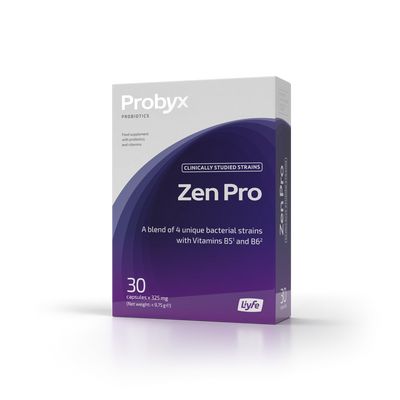
Probyx ZenPro™ was developed within this conceptual framework as an outcome-led microbiome formulation designed to support stress resilience and emotional balance through modulation of the gut–brain axis. Rather than framing emotional well-being as a function of isolated neurotransmitter pathways, ZenPro is formulated on the premise that emotional regulation emerges from coordinated interactions between gut microbial activity, immune signaling, and neuroendocrine responses. The product is based on the Bifizen® probiotic blend developed by Probiotical, comprising Bifidobacterium lactis BL04, Lactobacillus fermentum LF16, Lactobacillus plantarum LP01, and Lactobacillus reuteri LR06. These strains were selected not as generic probiotics, but as a defined consortium that has been evaluated collectively in human clinical trials exploring stress-related mood parameters and emotional well-being, making them effective stress resilience probiotics.
Biological and Mechanistic Foundations
The biological foundations of ZenPro are rooted in the structure and function of the gut–brain axis. Communication between the gastrointestinal tract and the central nervous system occurs through overlapping neural, immune, endocrine, and metabolic pathways. Signals transmitted via the vagus nerve, circulating cytokines, stress hormones such as cortisol, and microbial-derived metabolites collectively influence stress perception, emotional processing, and behavioral responses, making it essential for emotional balance supplements.
Chronic psychological stress has been shown to alter gut permeability and immune activation, promoting a pro-inflammatory environment that may amplify stress responsiveness and impair emotional regulation. Conversely, alterations in gut microbial composition can influence stress-related neuroendocrine signaling, creating a bidirectional feedback loop between psychological stress and gut physiology. Within this context, stress resilience probiotics, including specific strains, may exert indirect effects on emotional states by stabilizing gut barrier integrity, modulating immune tone, and influencing the availability of neuroactive compounds involved in mood regulation.
The Bifizen® blend used in ZenPro reflects an integrative mechanistic strategy. Bifidobacterium lactis BL04 has been investigated for its interactions with immune modulation and gut barrier support, both of which are relevant in stress-associated states. Lactobacillus plantarum LP01 has been explored for its role in maintaining intestinal homeostasis and microbial balance, contributing to a stable gut environment conducive to balanced gut–brain signaling. Lactobacillus fermentum LF16 and Lactobacillus reuteri LR06 have been examined in relation to stress- and mood-associated outcomes, with interest in their potential to influence emotional parameters through microbiota-mediated pathways. This microbiome formulation combines these strains to function as a coordinated system rather than as isolated agents, reflecting the distributed nature of emotional regulation.
Clinical Evidence Landscape
Human clinical research examining the relationship between emotional balance supplements and emotional well-being has expanded considerably over the past decade. While early investigations focused primarily on gastrointestinal endpoints, more recent studies have incorporated psychological outcomes such as perceived stress, mood state, sleep quality, and overall emotional well-being. These studies span both healthy individuals and populations experiencing stress-related or subthreshold mood symptoms.
Within this body of literature, it is essential to distinguish between trials evaluating undefined probiotic supplementation and those investigating specific, well-characterized strain combinations, particularly in the context of stress resilience probiotics. Outcomes in stress and mood research are highly sensitive to study population characteristics, baseline psychological status, and the microbiome formulation employed. For ZenPro, the most relevant evidence is derived from trials evaluating the same strain consortium incorporated into the product, thereby providing direct translational relevance.
Named Clinical Trials and Outcomes
In the randomized, placebo-controlled study by Moschonis et al., published in the British Journal of Nutrition, the Bifizen® probiotic blend was evaluated in adults reporting subthreshold depressive symptoms. Primary outcomes included changes in mood-related parameters assessed using validated psychological questionnaires, while secondary outcomes explored broader measures of emotional well-being. Compared with placebo, individuals receiving the probiotic blend demonstrated improvements in mood-related scores. These changes suggest that this microbiome formulation can effectively influence emotional parameters in individuals experiencing stress-related mood disturbances without a diagnosed depressive disorder, making it one of the promising emotional balance supplements available.
In a further randomized, placebo-controlled study by Walden et al., published in Frontiers in Nutrition, the same probiotic strain combination was examined in adults experiencing psychological stress. Primary outcomes included validated measures of perceived stress and mood, with secondary outcomes assessing related indicators associated with stress response. Participants receiving the probiotic blend showed changes in stress-associated mood parameters compared with placebo. These findings reinforce the consistency of observed effects across different populations and highlight the relevance of these stress resilience probiotics to emotional balance.
Evidence Synthesis and Scientific Interpretation
Taken together, the available clinical evidence supports a coherent scientific narrative regarding emotional balance supplements. Trials evaluating the Bifizen® blend demonstrate changes in mood- and stress-related outcomes compared with placebo in stressed or subthreshold populations. These findings align with mechanistic models of gut–brain communication, where microbial modulation influences immune and neuroendocrine pathways involved in stress resilience and emotional regulation.
The magnitude of observed effects is modest, which is consistent with expectations for nutritional interventions like microbiome formulations that act on complex physiological systems. Importantly, the directionality and reproducibility of these outcomes across independent studies strengthen the plausibility of a microbiome-mediated effect. At the same time, the evidence does not support claims related to the treatment of psychiatric disease, underscoring the importance of appropriate scientific restraint in interpretation.
Conclusion
Probyx ZenPro™ represents a scientifically coherent application of microbiome research to support stress resilience and emotional balance. Its formulation is grounded in contemporary understanding of the gut–brain axis as an integrative biological system linking microbial activity with immune, endocrine, and neural regulation. By incorporating the Bifizen® multi-strain blend, ZenPro aligns its microbiome formulation with human clinical evidence demonstrating changes in mood-related outcomes in adults experiencing psychological stress or subthreshold mood disturbances. The convergence of formulation rationale, mechanistic plausibility, and observed clinical outcomes supports ZenPro as a rational, evidence-aligned approach to emotional balance supplements within modern nutritional science.